
Every serious student of chess eventually asks the same question:
“Which database should I use?”
Today’s chess world is rich with tools. Each claims to unlock deeper insight into openings, middlegame plans, and historic grandmaster games.
But not all databases are built the same. Some are powerful and professional. Others are free and accessible. Some excel in raw data size. Others in ease of use.
In this practical comparison, we’ll explore three leading chess database tools:
- ChessBase
- Lichess Database
- Chess.com Explorer
You’ll learn what each one is, how they differ, and which one best serves your needs.
A Tale of Three Explorers
Imagine you’re preparing against a new opponent. You want to know:
- What openings do they play most
- How often do they deviate from theory
- Which lines give them trouble
You open your database. But what you see depends entirely on which database you’re using.
One might show millions of master games from history.
Another shows how players worldwide are currently responding.
And a third shows trends from a huge pool of online games, but it requires a subscription.
These differences matter. They change what you learn, and they shape your preparation.
Let’s break them down one by one.
ChessBase: The Professional Standard
ChessBase is the most established and widely used professional chess database on the planet.
It began in 1986 and still sets the gold standard for serious preparation and deep research.
What ChessBase Actually Is
At its core, ChessBase is software, a database management program. It lets you:
- Store and search games
- Filter positions by patterns or player names
- Build custom opening trees
- Attach annotations and engine evaluations
- Prepare opponent-specific game collections
ChessBase doesn’t just give you games; it lets you organize and analyze chess data in powerful ways.
Key Strengths of ChessBase
1. Massive Game Collections
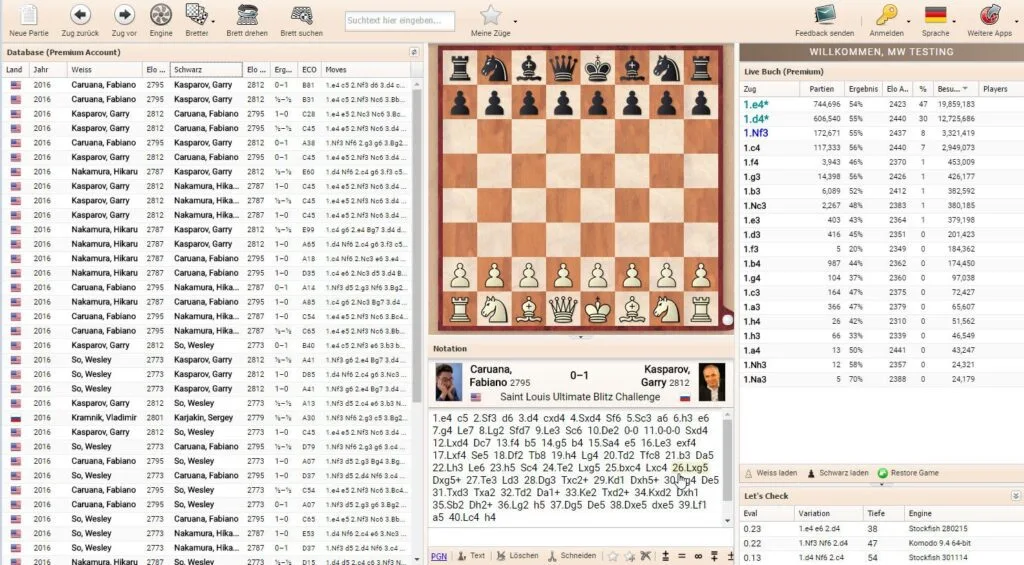
ChessBase’s databases contain millions of games, including many historical, classical, and annotated games. Some editions include up to 8-11+ million games.
Many of these are OTB (over-the-board) games.
2. Deep Search and Filtering
ChessBase allows you to search by:
- Opening code
- Player name
- Material imbalance
- Tactical themes
- Endgame patterns
It provides deeper filtering than most online explorers.
3. Annotated Games and Study Tools
Many ChessBase databases include master annotations, which offer insights beyond just moves. This is invaluable for any player looking to learn why certain lines work and others don’t.
4. Integration With Engines
ChessBase supports external engines, such as Stockfish, for deep analysis. It also supports tablebases for perfect endgame play.
5. Strong Professional Ecosystem
Top players and coaches around the world use ChessBase for preparation. It has become a standard in professional chess.
Limitations of ChessBase
With all its perks, ChessBase also comes with a few challenges, especially for beginners.
1. Cost
ChessBase software is commercial. You must pay for full versions and major databases. Smaller databases are cheaper, but the most complete ones are pricey.
2. Learning Curve
With all its power, ChessBase also comes with complexity. Beginners often find ChessBase intimidating at first encounter.
3. Format Dependency
ChessBase uses proprietary formats (like .CBH). You sometimes need to convert PGN files or use specific tools to import other databases.
Lichess Database & Lichess Opening Explorer: The Free Powerhouse
Lichess is a completely free, open-source chess platform founded in 2010.

All features, including the database and explorer, are available to everyone without paywalls.
Lichess is the common man’s chess database, accessible to anyone with a working internet connection.
What Makes Lichess Unique
Lichess’s database is massive and continuously updated. They release monthly or periodic database exports under the Creative Commons CC0 license, which is free to use and redistribute.
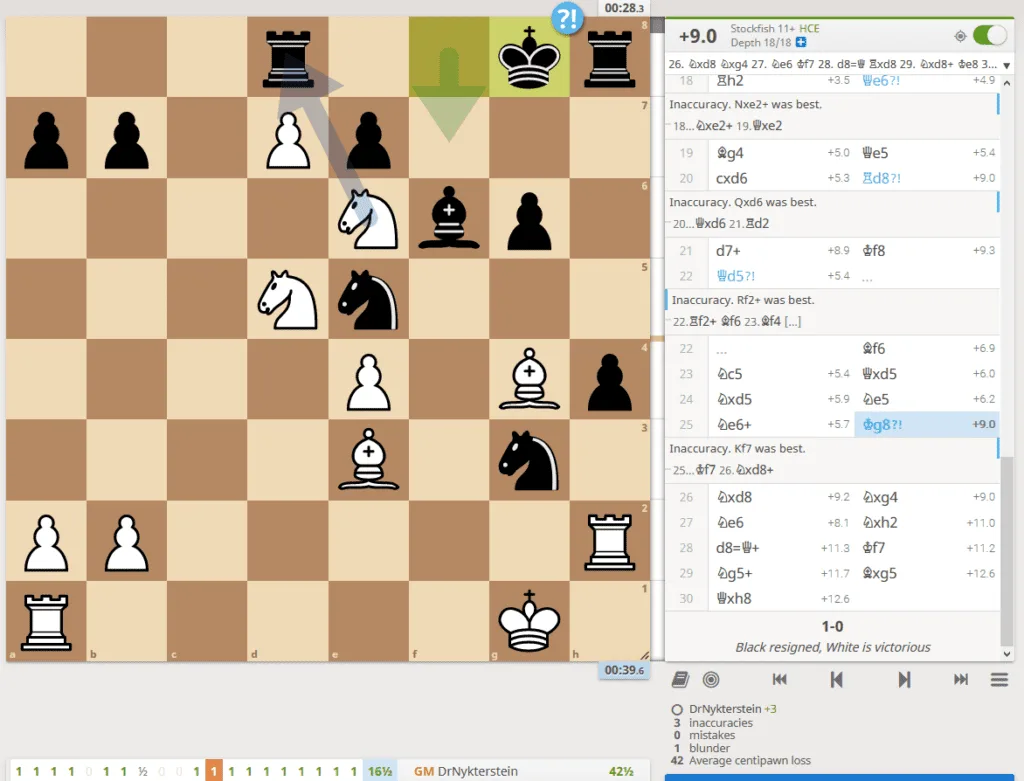
Lichess’s Opening Explorer isn’t a static dataset. It is a carefully organized system that gives access to:
- A Masters Database
- A Lichess Games Database (millions of games from Lichess players)
- A Player Database that is filterable by users
This means you can explore not just master games, but also how real players across different rating strengths use openings in practice.
Strengths of Lichess Database
1. Completely Free
Lichess requires no subscription. It is completely free. Every feature, including Deep Analysis and Opening Explorer, costs nothing.
2. Open and Transparent
Lichess’s database is open-source. You can download the raw PGN data and use it in any tool you like.
3. Player Filtering
You can explore games by specific players by searching for and going through their Lichess accounts. This is something few other explorers do.
4. Huge Data Set
Lichess data includes millions of games played online under real conditions. You get a sense of practical play across all skill levels.
Limitations of Lichess Database
1. Not Always Complete for Historical Games
Lichess focuses on online games. Older classical games or rare historic matches may not be in the explorer unless uploaded separately. This means you might miss some long-ago OTB games.
2. Interface and Search Depth
Although excellent for opening trends, Lichess lacks the depth of advanced search features (such as motif-based searches) compared to ChessBase. Filtering by complex criteria (e.g., pawn structure motifs) isn’t possible in the web explorer alone.
3. Mixed Quality Data
Because many games come from online play across all rating levels, not all statistics reflect high-level theoretical practice unless you filter to the Masters database.
Chess.com Explorer: The All-in-One Online Tool
Chess.com is the largest chess platform in the world, with over 200 million users.

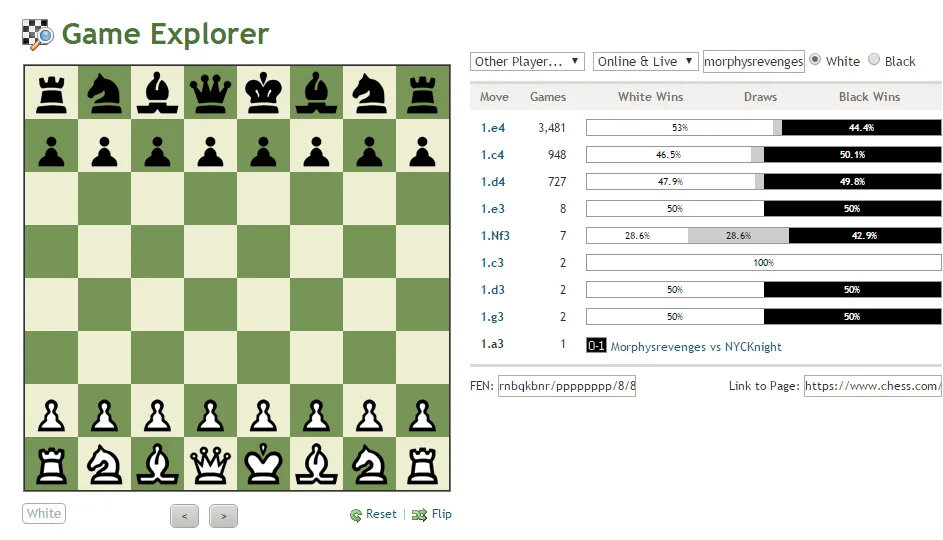
Its Explorer (called Game Explorer in the Analysis panel) gives database statistics, game frequency, win rates, and notable games from its master database.
What Chess.com Explorer Actually Provides
According to Chess.com’s own documentation, the Explorer includes nearly 3 million master games, all played by titled players and updated regularly.
It shows:
- Move frequency
- Win/draw/loss statistics
- Engine evaluations for moves
- Notable games where the position occurred
All of this is displayed directly in the analysis interface, making it very accessible.
Strengths of Chess.com Explorer
1. Integrated Workflow
You don’t need to leave the analysis board to explore moves. The Explorer pops up right there alongside computer analysis.
2. Nice Visuals and Stats
Chess.com’s presentation is polished and beginner-friendly. Win rates, popularity bars, and notable games are clearly visible.
3. Depth for Master Play
The master database focuses on high-level games, giving reliable opening statistics for serious preparation.
4. Personal Game Context
You can switch the Explorer to include your own games or games from other specific users.
Limitations of Chess.com Explorer
1. Requires Subscription for Full Features
Some Explorer features (like deeper game lists or certain filters) require a premium membership.
2. Smaller Database than ChessBase
At around 3 million games, Chess.com’s database is smaller than major ChessBase offerings.
3. Limited Filtering Power
Compared to ChessBase, you cannot filter by very detailed structural or tactical criteria.
Head-to-Head Comparison
| Features | ChessBase | Lichess Database | Chess.com Explorer |
| Cost | Paid | Free | Freemium |
| Database Size | Millions | Millions (Lichess+Master Games) | Millions |
| Historical Games | Excellent | Good, but not complete | Good but small |
| Best For | Coaches/ Professionals | Casual to Intermediate | Casual to Intermediate |
Which One Should You Use, And When
Use ChessBase if:
- You want deep preparation for high-level tournaments
- You need detailed search filters (motifs, patterns, player statistics)
- You want annotated games with historical context
Use Lichess Database if:
- You want free access to a huge set of games
- You’re studying practical trends across ratings
- You want open downloadable data you can use in your tools
Use Chess.com Explorer if:
- You’re analyzing games and openings in one place
- You enjoy a polished interface and integrated stats
- You want insights tied directly to your own play
Practical Example: Studying 1.e4 c5 (Sicilian Defense)
Let’s say you want to study the Sicilian Defense.
- ChessBase will give you millions of games across history, filterable by player, year, and result. You can find rare novelties, annotate lines, and export for training.
- Lichess Database will show you trends from millions of online games, win rates across skill brackets, and how the Sicilian is played today.
- Chess.com Explorer shows master play and statistics with move percentages and notable games.
Each delivers useful info, but in different ways.
How to Combine Them for Best Results
You don’t have to pick just one. Many strong players use all three, each for a specific purpose. They:
- Use Lichess Explorer to survey current online trends.
- Use Chess.com Explorer to validate master games.
- Use ChessBase to investigate deep historical theory and extract annotated instructions.
The combination gives both breadth and depth.
Common Mistakes Players Make With Databases
Regardless of platform, players often misuse databases.
Here are the biggest errors and how to avoid them:
1. Memorizing Moves Without Ideas
Many players scroll through database games and simply copy moves, thinking that memorization equals understanding.
The problem is that moves alone don’t teach plans, goals, or typical middlegame strategies.
If you memorize without grasping the idea behind a move:
- You forget lines quickly
- You panic when the opponent deviates
- You fail to recognize patterns in similar positions
How To Fix it: After each key move, pause and ask yourself:
- Why was this move played?
- What threat does it address or create?
- Which plan does it support?
Understanding why a move works is more valuable than remembering what the move is.
2. Trusting Win Percentages Blindly
Database statistics can be misleading. A move showing a 62% success rate might seem strong, but that number depends on player rating and time controls.
Online games may inflate the success of risky gambits, while solid theory lines may look “less successful” simply because they often lead to draws.
How To Fix it: Treat percentages as a guide, not a verdict. Always check context: who played the line, under what conditions, and against what level.
3. Ignoring Time Control Differences
Many players mix data from blitz, rapid, and classical games without considering how time affects play. A move that thrives under five-minute pressure may fail completely in a two-hour classical game.
How To Fix it: Match your database study to your intended time control.
4. Letting Engines Replace Thinking
Databases often integrate chess engines like Stockfish. Many players then rely on these engine suggestions without considering why a move is recommended.
How To Fix it: Analyze first with your own reasoning. Then check the engine. Use it to validate your ideas, not dictate your moves.
Conclusion
Databases aren’t just about how many games they have.
They’re about:
- The quality of games
- The ease of filtering and searching and;
- The context you need for practical study
Each database has a role in modern chess preparation. The smarter you use them, the stronger your understanding of the game becomes.