
In the ever-growing world of online improvement chess platforms, ChessDojo has carved a name for itself.
Founded by International Masters David Pruess and Kotsya Kavutskiy, along with Grandmaster Jesse Kraai, the platform offers a structured and community-driven path to chess mastery.
With the promise of a “structured learning plan to take your chess from 0 to 2400,” ChessDojo attempts to serve as the go-to training platform.
But is ChessDojo really worth your time and money? In this article, we will look at the training program, tools, community, and overall value for players.
What is ChessDojo?
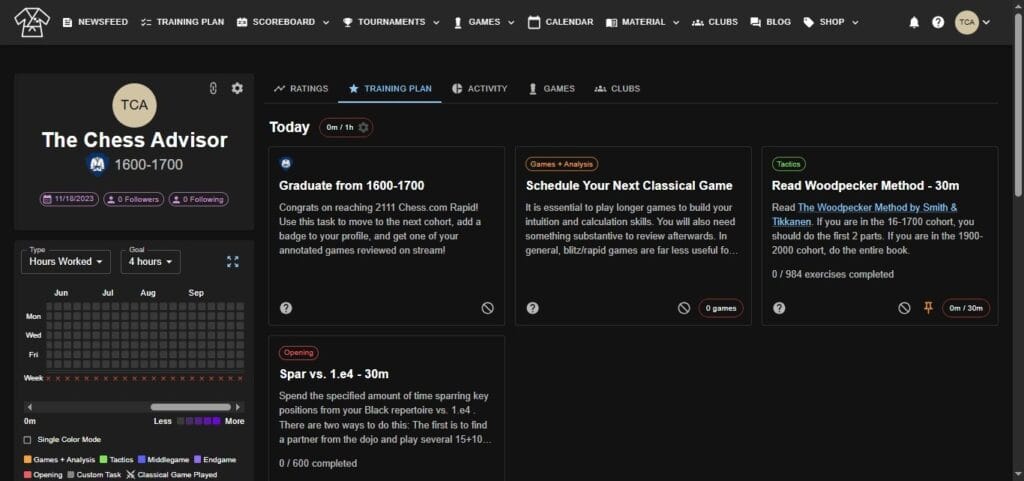
ChessDojo is more than just a normal training website. It is essentially a whole ecosystem built to guide players through the process of a structured improvement.
It integrates practical study plans, classical gameplay, mentorship, and community accountability into a cohesive platform, offering a comprehensive approach to chess improvement.
Understanding the rationale behind ChessDojo is straightforward because of the typical lack of structured training methods to get better at chess.
A lot of players don’t have a clear path to train and improve their chess strength. Some suffer from information overload.
ChessDojo is the bridge between information, habit, and chess improvement, and they seem to do that solidly well.
The ChessDojo Training Program
ChessDojo is built for one reason alone: to train your chess.
Structured by Rating
This is the standout feature on ChessDojo. Other training websites that offer general training programs do not tailor their plans based on the player’s rating like ChessDojo does.
However, on ChessDojo, there are roadmaps for players ranging from 0 to 2500, each with a different training plan for openings, tactics, endgame, and game analysis.
Each plan typically includes:
- Long-time control games to encourage deep thinking.
- Game analysis habit tracker to help you find recurring weaknesses.
- Tactics and endgame targets for the rating bracket.
- Model games and recommended books or courses.
Progress Tracking and Accountability
The platform offers a training dashboard where users can track their study hours, analyze and annotate games, and keep tabs on their rating progress. Apart from that, there are daily trackers to organize training tasks.
Community Support
Members can easily schedule sparring games and opening practice through the Dojo. This makes it easy to replace unstructured online play with a focused and purpose-driven practice.
The platform also uses Discord for community communication and interaction.
The Features and Community
Analysis Board
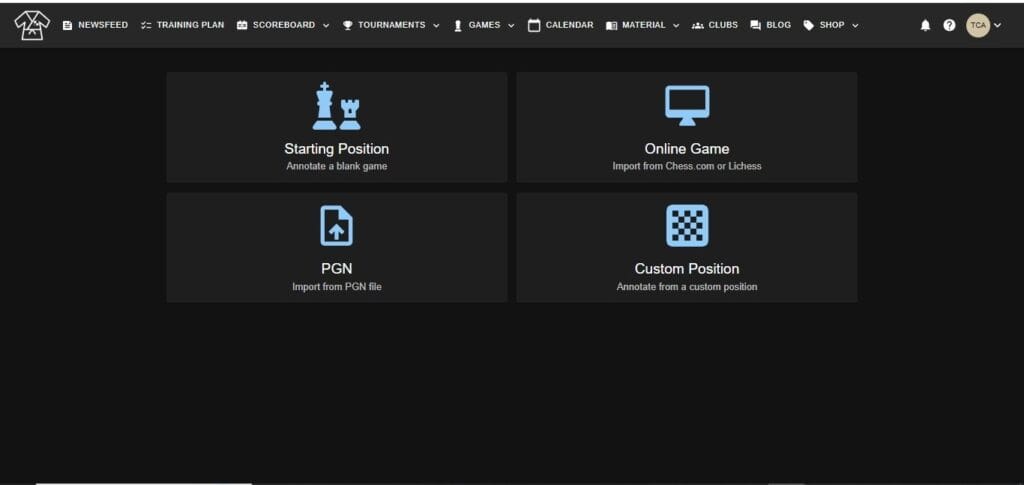
ChessDojo offers a distinctive analysis board that enables users to import games from online sources, start with a blank position, analyze custom positions, and even import from PGN sources.
You can analyze custom positions or import them from PGN sources on the platform.
Game Database
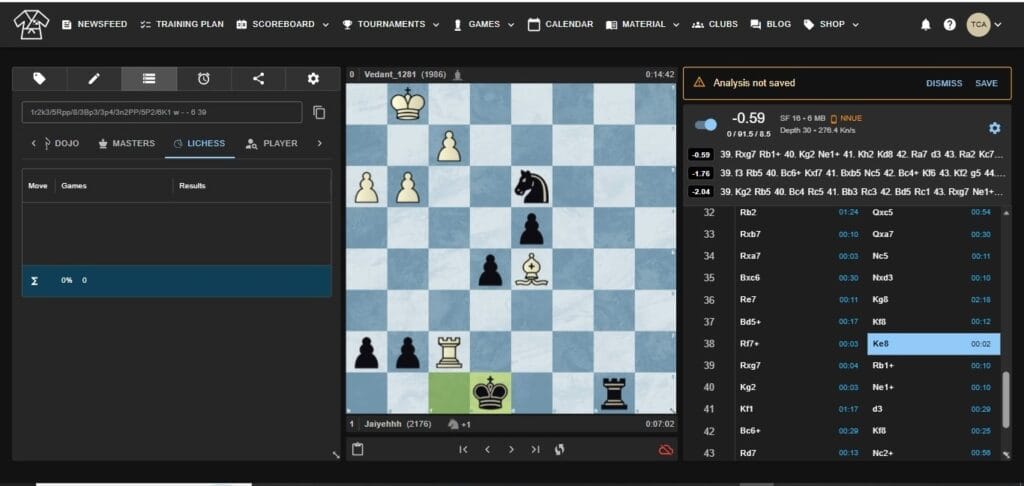
The ChessDojo Analysis feature with the Game database, showing on the left.
ChessDojo provides a database of games for its users to play through, analyze, reference, or study.
Discord Server
The ChessDojo Discord server is essentially the community heartbeat. Members can engage in discussions about study plans, share annotated games, and coordinate matches within the community.
While some users may find the Discord platform cumbersome, the undeniable utility of the community for discussions, sharing games, and organizing matches outweighs this potential inconvenience.
Twitch, YouTube, and Dojo Talks
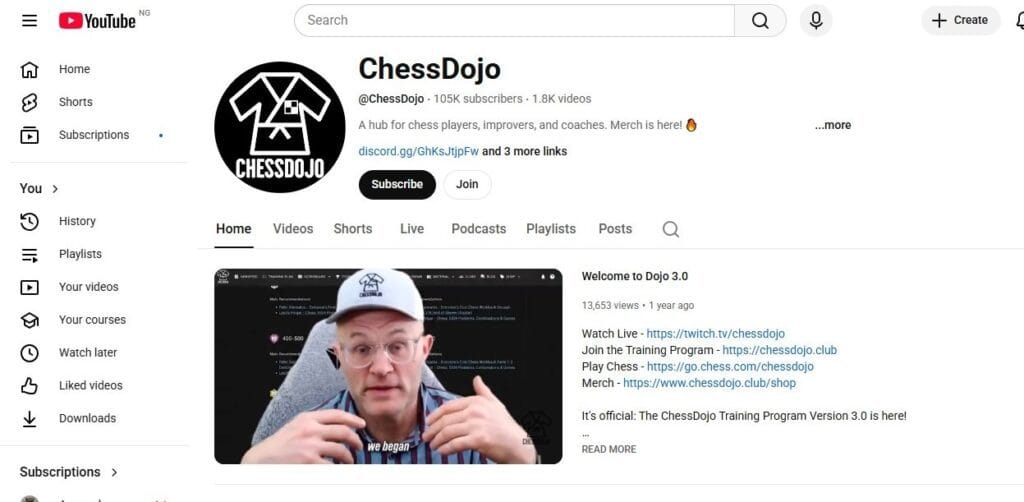
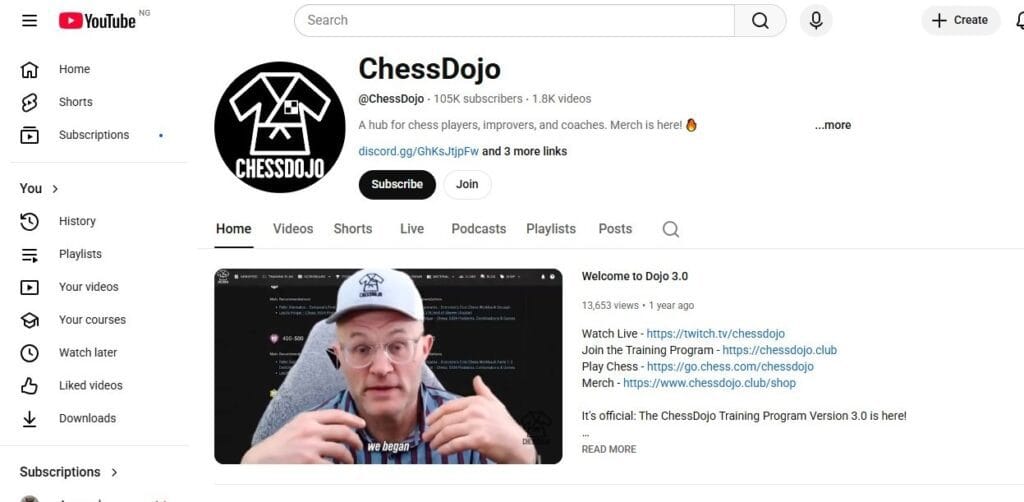
Their Twitch and YouTube channel features insightful games, reviews, lectures, and “Dojo Talks”—podcast-style discussions that offer humor, chess insight, and coaching wisdom. It’s an excellent addition to the ChessDojo platform.
Pricing and Value for Money
As of 2025, ChessDojo’s membership costs about $15 per month or $120 per year. The free plan is also available with extremely limited access, but it is useful for newcomers to explore the basics before subscribing.
When compared with private coaching (which is usually about $40-100 per hour), ChessDojo provides exceptional long-term value for motivated players seeking improvement on a budget.
Pros and Cons
Pros
- Structured rating-based plans from absolute values to 2500.
- Community accountability and a serious training culture.
- Focus on classical chess and real improvement, not blitz habits.
- Affordable compared to private coaching.
- Rich content (model games, annotated studies, Dojo Talks, Twitch sessions).
Cons
- High commitment required: Success with ChessDojo depends on consistent long-game play and deep analysis.
- Community size varies: Stronger players (2000+) may find fewer sparring partners at their level.
- Not for casual blitz players: The platform’s structure doesn’t reward quick or shallow study.
- Limited direct coaching: Feedback depends on community engagement, not professional sessions.
Who is ChessDojo best for?
ChessDojo is meant for players who have the time and commitment to work on working through the tasks and books needed to improve their play.
It is ideal for
- Serious Improvers: Players willing to dedicate time (hours) weekly or daily to structured study and classical games.
- Club/tournament players (1000-1900): Those who need guidance, discipline, and accountability
- Adult Improvers: Anyone returning to chess who wants a clear roadmap to improvement.
It is not ideal for
- Blitz or casual players with little time on hand.
- 2100+ FIDE players seeking elite-level sparring.
- Absolute beginners who prefer visual, app-style lessons over self-guided work.
How ChessDojo Compares to Other Training Platforms
While ChessDojo focuses on structure and accountability, many other training platforms offer more content-heavy learning experiences. Here’s how it compares with other popular choices:
Chess.com Lessons
Chess.com offers tons of expertly created videos and puzzles, but lacks the personal discipline ChessDojo enforces. The Dojo gives you a clear roadmap; Chess.com gives you lessons and courses to use for your learning.
Chessable
Chessable is excellent for memorizing openings or endgames with its “MoveTrainer” feature. ChessDojo complements it by making sure you apply what you learn in actual games through practice.
Aimchess
Aimchess uses analytics to diagnose weaknesses based on your online games. ChessDojo instead focuses on deliberate practice (slow games, reflection, and human feedback.)
Lichess Studies
The study feature on Lichess is free and versatile, but entirely self-guided. ChessDojo brings the missing accountability, structure, and social learning.
In short, if other platforms are your “study materials,” ChessDojo is the “training gym” where you actually apply them.
Final Words
In an era of dopamine-based speed chess addiction, ChessDojo brings back the classical art of serious chess training.
Instead of the trial-and-error approach of playing hundreds of blitz and bullet games, you are forced to work on your weaknesses through active study. It is demanding, but that is why it works.
Suppose you are a club player, adult improver, or tournament player ready to put in the effort toward improvement. In that case, Chessdojo is one of the best-value training platforms available for you.
It is not just another chess app; it is a community with a plan for real improvement. With ChessDojo, you should be on track for your next perfect tournament performance.