
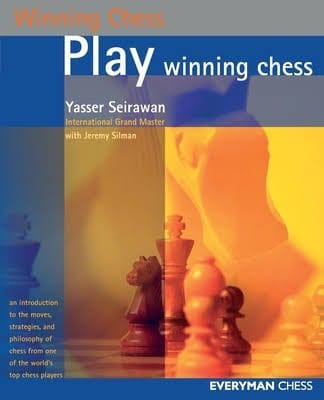
Play Winning Chess by Yasser Seirawan is a must-read for any chess player embarking on a journey to chess mastery. The book is written as a collaboration between Jeremy Silman and Yasser Seirawan.
Initially published in 1990 by Tempus Books, a division of Microsoft Press, it quickly became a chess classic.
Play Winning Chess was the first in a series of six books, with others like Winning Chess Tactics and Winning Chess Combinations, also becoming quite popular among chess players.
The book focuses on the major chess principles, which is one reason for its popularity.
About the Book and the Author
Yasser Seirawan remains one of the most influential chess players of all time. Leaving a mark on different aspects of the game, he was born on March 24, 1960.
Born in Syria, he immigrated with his family to Seattle, Washington. He picked up chess at 12 and soon became the Washington Junior Champion at 13.
He qualified for several Candidates tournaments, part of the World Chess Championship Cycles, and eventually became one of the highest-rated Americans.
Having played in the elite circle for several years, he remains one of the most decorated American Chess players, with four United States Chess Championships under his belt.
Apart from his professional chess-playing career, he is a chess author, coach, and one of the most renowned commentators.

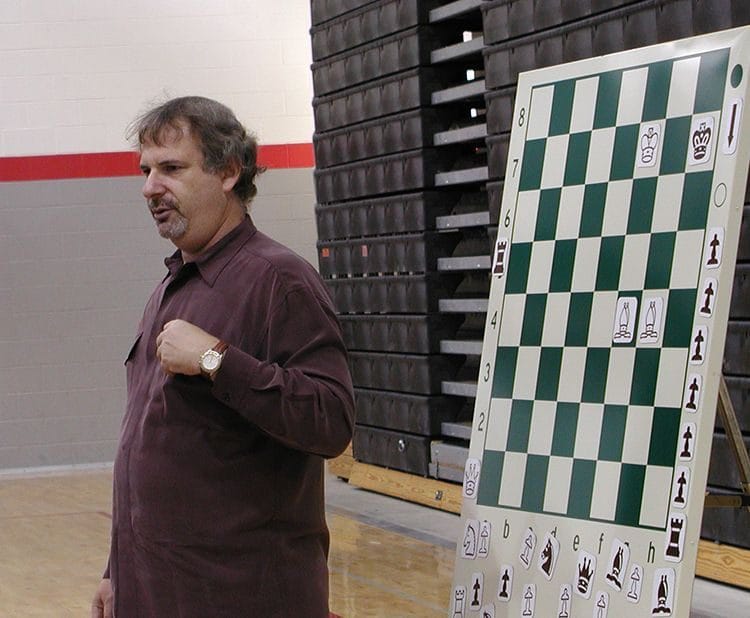
Yasser Seirawan is a resident of St. Louis, where he works as a commentator and spokesperson for the St. Louis Chess Club. Photo Credits: St. Louis Chess Club.
Jeremy Silman was an American International Master, author, and one of the most influential chess teachers of the modern era, best known for his “imbalances” framework that reshaped how players think about strategy.
His clear writing, groundbreaking instructional books, and contributions to chess education made him a beloved figure whose work continues to guide players worldwide.
Play Winning Chess is a foundational chess book aimed at beginning and intermediate players. It teaches the core principles needed to win games.
The concepts in the book are presented in an easy-to-read, story-like way, with no heavy theory; emphasis is on practical understanding.
Book Content Summary
The book has seven chapters, four of which highlight the major chess principles. The chess principles detailed are:
- Force
- Time
- Space
- Pawn Structure
These four principles are the backbone of any chess game.
The first chapter, The Evolution of Chess, details the origin of the game in India and Asia in the 7th century. Then, through Persia and Arabia, before finally moving to Europe when the Moors conquered Spain in the 8th century.
It also explains how the pieces evolved into the modern form we have today. The cultural importance of chess is mentioned, and the prominent women in Chess history are highlighted.
The chapter also teaches how to play chess, read chess notation, use a chess clock, and introduces the basic equipment of the game. This chapter shows the rich history and the universal appeal.
The second chapter covers the first primary principle of Force. As described, force simply refers to the strength of the pieces, individually or collectively.
If a side has an extra piece, they have more force and thus, a clear path to victory.
The book introduces the standard piece value and explains material imbalances.
It also touches on playing styles which can be romantic, tactical or strategic. It also outlines basic tactics.
The third chapter explains Time, which in Chess means the development and speed of mobilisation, not the clock.
A time advantage is when you bring your pieces into the game faster than your opponent does. The chapter emphasises how beginners typically rush into premature attacks.
Emphasis is placed on proper development as a key to gaining time. The chapter also guides positional play and provides examples of great players known for this style.
The fourth chapter introduces Space. A space is defined as the control over more territory than the opponent.
Often, with a space advantage, pieces enjoy freedom while the opponent becomes cramped.
The book presents a simple space-counting method and illustrates how open files, diagonals, and outposts become more powerful as you have more space.
The fifth chapter emphasises Pawn Structure. It highlights why pawns, often considered the weakest units, are strategically important.
Like Philidor once stated, “Pawns are the soul of Chess”. The importance of Pawns is emphasised in the chapter, and the pawns’ weaknesses, such as doubled, tripled, isolated, and backward pawns, are explained.
It also stresses how pawn structure affects the king’s safety and long-term plans, and why it is essential to prevent weaknesses rather than try to fix them later.
The sixth chapter provides annotated Master games to illustrate the preceding principles in action. In contrast, the seventh chapter, The Four Principles and You, offers practical advice on applying them to any playing style.
Pros
- Beginner-friendly: The explanations are clear and ideal for beginners.
- Strong fundamentals: Teaches our core principles (Force, Time, Space, Pawn Structure) that every player must know.
- Engaging writing: Seirawan’s friendly style makes the book enjoyable and easy to follow.
- Good historical context: Explains the origins of chess and how pieces evolved, adding depth and relatability to the learning experience.
- Practical examples: Uses annotated games and diagrams that help beginners understand actual positions.
Cons
- Too basic for advanced players: Stronger players may find the concepts too elementary.
- Oversimplified ideas: Some topics lack the nuance found in more modern or advanced books.
- Dated examples: Some games come from older eras and may not reflect modern chess theory.
Who is this Book For?
The book is suited for beginners and early intermediate players. Players who want a clear, friendly introduction to core chess principles for improving their game will find it both instructive and ideal.
Final Words
In the end, Play Winning Chess remains one of the most bankable choices for anyone serious about learning the fundamentals of chess.
The clarity and emphasis on core principles make it an evergreen choice.
It is a reminder that every strong player started with the basics, and a mastery of them is the surest way to chess improvement.
Overall, a splendid read.